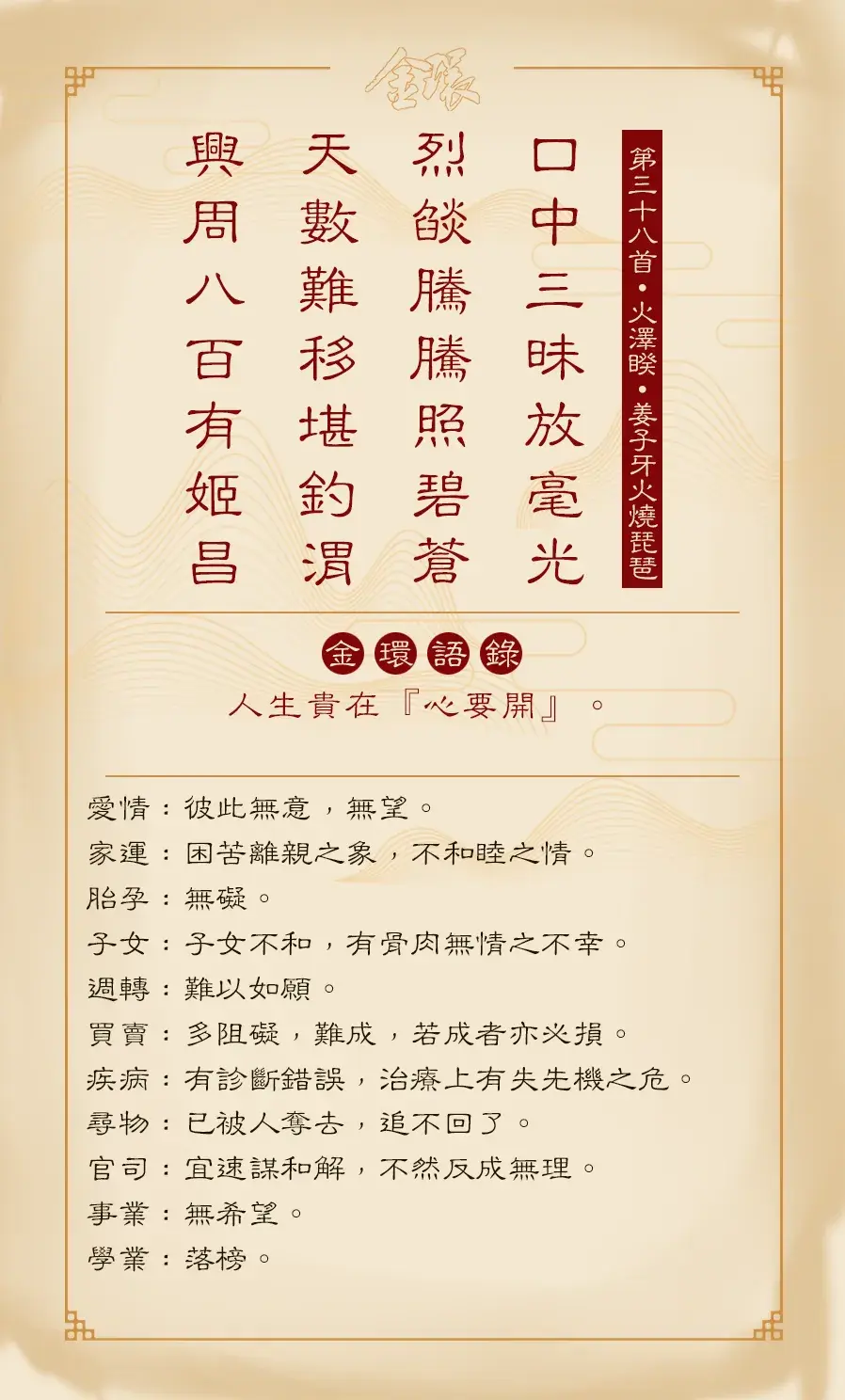
This hexagram, named "Kui," means opposition or estrangement. In a situation of opposition and conflict, one should be gentle and magnanimous, seeking common ground while respecting differences, to gradually eliminate estrangement and opposition and achieve harmony. Kui symbolizes danger, rebellion, and estrangement. It indicates an inauspicious outcome. It signifies disagreement, mutual conflict, stubbornness, and disharmony. Everything will be unfavorable, and there is a risk of betrayal; beware of petty people. The upper trigram is Li (fire), whose nature is to rise. The lower trigram is Dui (marsh/lake) with metal, whose nature is to descend. This signifies one rising and one descending, and moreover, they mutually counteract. Fire overcomes metal, and water overcomes fire. This mutual opposition extends to disagreement and unwillingness to yield, leading to mutual harm. Because the yin lines are in the third and fifth positions, which are yang positions, it implies a yin line (female) occupying a correct position, suggesting illegitimacy or a lack of popular support, and an unreasonable and obstinate disposition.